

Top 8 Customer Rewards Platforms for US Retailers & Enterprises in 2026

Last Updated: 13th January, 2026
A customer rewards platform is an end-to-end system that enables brands to design, personalize, and manage loyalty programs across channels, combining reward earning, redemption, and fulfillment in a single platform. Unlike basic loyalty software, it includes a consumer-facing rewards marketplace, real-time personalization, omnichannel engagement, and integrated reward delivery. Businesses use customer rewards platforms to increase repeat purchases, customer lifetime value, and retention through personalized, data-driven customer experiences.
This guide compares eight industry-leading customer rewards platforms, their strengths, ideal use cases, and implementation considerations. Whether you're a retailer seeking behavioral loyalty, a SaaS company building customer stickiness, or a hospitality brand focusing on experiential rewards, you'll find the right platform for your business model.
Why Customer Rewards Is Crucial for Brands
The retail and customer engagement landscape has fundamentally shifted. Brands have to perform beyond just their products or services, they must compete on customer experience and emotional connection. For most industries, rewards programs have become strategic imperatives.
What Has Changed
Rising acquisition costs make retention more economical than continuous replacement. Consumers reject generic discounts and expect personalized rewards tied to individual behaviors. Customers engage across fragmented channels (in-store, online, mobile, social, marketplaces), requiring unified omnichannel orchestration. Modern consumers share behavioral data for genuine value, making real-time personalization the baseline expectation.
Business Impact and ROI
Well-designed rewards programs drive measurable outcomes: higher repeat purchase frequency, increased average order value, cost-effective customer reactivation, elevated referral rates, and first-party behavioral data that fuels personalization and incrementality measurement.
88% of consumers are likely to join a loyalty program when offered an incentive that resonates with their values, signaling strong baseline demand. 74% of engaged loyalty members actively modify their spending patterns to maximize rewards benefits, demonstrating intentional behavior change.
The real-world impact is striking: Delta Air Lines generates 57% of total company revenue from its loyalty program, and United Airlines' loyalty division generated $1.8 billion in EBITDA (26% of total EBITDA). Loyalty programs often represent the single largest profit driver for mature brands. Brands that invest in sophisticated customer rewards platforms see measurable returns through increased frequency, higher AOV, improved retention, and critically, higher customer lifetime value.
What is a Customer Rewards Platform?
A customer rewards platform is an end-to-end solution that combines loyalty program design, consumer-facing rewards marketplaces, omnichannel engagement, and integrated reward fulfillment. Unlike traditional loyalty software that focuses solely on backend program management, a true rewards platform orchestrates the complete member journey: enrollment, earning, personalized engagement, redemption, and fulfillment delivery.
What It Is and What It Isn't
A customer rewards platform includes all of these core components:
- Consumer-facing rewards marketplace — Members browse, search, and redeem from curated reward options, not just backend point tracking.
- Omnichannel engagement — Unified experiences across in-store (POS), online, mobile apps, and social channels.
- Integrated fulfillment — End-to-end reward delivery from issuance through customer receipt.
- Personalization engine — AI-driven behavioral insights that surface the right rewards to the right members at the right time.
- Advanced analytics — Measurement of ROI, redemption economics, CLV, and program incrementality.
What it is not: A customer rewards platform is not a simple points app, a discount platform, or a basic referral tool. It's not just loyalty software that lives in the backend without a consumer experience. It's not a payout platform focused solely on disbursement logistics.
Where It Sits in Your Stack
A customer rewards platform typically integrates with your broader martech and customer experience infrastructure: it connects to your CRM and CDP (for unified customer data), your e-commerce and POS systems (for transaction triggers), your marketing automation platform (for personalized campaign orchestration), and your payment systems (for seamless integration). The platform acts as the central nervous system for customer engagement and behavioral incentives, often serving as the bridge between customer data and marketing action.
Market Adoption and Consumer Expectations
The market is growing rapidly. The global customer loyalty market is projected to reach $28.8 billion by 2029, reflecting 17.3% compound annual growth. This growth is driven by rising consumer expectations: 81% of consumers say loyalty membership influences their purchase likelihood, and consumers increasingly expect programs to deliver personalization, mobile accessibility, and diverse reward types. The baseline expectation can be summarized as "understand me and offer rewards that match my preferences."
Features of a Customer Rewards Platform
A mature customer rewards platform is not a simple monolith—it's a suite of interconnected capabilities organized into three strategic layers. Understanding these layers helps you evaluate whether a platform can support your program's current needs and scale with future requirements.
Layer 1: Core Rewards Capabilities
The foundation layer handles the essential mechanics of any loyalty program. Reward types supported should include points, discounts, gift cards, experiences, partner offers, cash-like payouts, and charity donations. Different reward types drive different behaviors and appeal to different customer segments.
Earn and redeem logic is where program design comes to life. This means defining how members earn (transaction-based, behavior-based, milestone-based, gamified), setting constraints (minimum thresholds, expiration windows, segment-based earning multipliers), managing budgets (spend caps, monthly/annual limits), and enabling diverse redemption paths (points to gift cards, points to partner brands, points to experiences).
Reward delivery and fulfillment is critical: the platform must issue rewards instantly or on schedule, deliver across all channels (email, SMS, mobile app, in-store), and integrate with fulfillment partners for physical and experiential rewards. Speed matters—members expect near-instantaneous reward gratification.
Layer 2: Intelligence and Personalization
This is where rewards platforms differentiate from basic loyalty software. Segmentation and targeting should enable dynamic member grouping based on purchase history, engagement patterns, lifecycle stage, demographic data, and behavioral attributes. Segments should update in real-time as member behavior changes.
Next-best-reward and offer decisioning uses machine learning to identify which reward will most likely drive desired behavior for each individual member. Instead of one-size-fits-all campaigns, members see personalized reward recommendations tailored to their interests and spend patterns.
Triggering and automation powers member journeys: tier upgrade celebrations, win-back campaigns targeting lapsed customers, spend-accelerators timed to seasonal demand, milestone rewards for loyalty anniversaries. These journeys should be easy to configure without engineering involvement.
Layer 3: Enterprise Readiness
Integrations and APIs are non-negotiable. The platform should connect seamlessly with your CRM, CDP, marketing automation platform, e-commerce system, POS, payment processors, and third-party data sources. Look for pre-built connectors and robust APIs.
Fraud controls, liability, and governance protect your business: transaction verification, duplicate redemption prevention, real-time anomaly detection, audit trails, role-based access controls, and approval workflows. Compliance with data privacy regulations (GDPR, SOC 2) is essential.
Measurement and ROI tracking should answer critical questions: What's the incremental revenue generated by program members vs. non-members? What's the cost per redeemed reward? Which reward types drive the highest engagement? Attribution modeling that isolates program impact from other marketing activities is crucial for demonstrating ROI.
Common Use Cases
Customer rewards platforms excel across diverse scenarios: win-back campaigns targeting inactive members with personalized incentives; service recovery offering immediate compensation for poor experiences; spend accelerators rewarding higher transaction values during key selling seasons; partner-funded rewards where partners subsidize redemption costs; milestone rewards celebrating customer anniversaries and loyalty thresholds.
Understanding these three layers—core rewards mechanics, intelligent personalization, and enterprise governance—gives you a framework for evaluating which platform matches your organizational maturity, technical capabilities, and business objectives. The best platform for a startup SMB is fundamentally different from the best platform for a global enterprise managing coalition loyalty across dozens of brands.
Customer Rewards Platform vs. Loyalty Program Software
The terms are often used interchangeably, but the distinction is critical. Understanding the difference will help you avoid common pitfalls: implementing software without the right consumer experience layer, or paying for platform capabilities you don't need.
Loyalty Program Software Definition
Loyalty program software is backend-focused. It excels at program design, rule management, and analytics dashboards. It helps you define tiers, earning logic, point expiration, and member segmentation. But it typically lacks a robust, branded consumer-facing rewards marketplace. Members check their points balance in a basic portal, but redemption options are limited or require manual intervention.
Customer Rewards Platform Definition
Customer rewards platforms are end-to-end solutions. They include everything loyalty software provides—plus a consumer-facing rewards marketplace, omnichannel engagement orchestration, integrated fulfillment partnerships, and real-time personalization. Members browse and redeem from curated reward catalogs within branded mobile apps or web experiences. The platform handles fulfillment directly, delivering gift cards instantly, managing experiential reward bookings, and integrating with partner networks.
Comparison Table: Choosing between Rewards Platform and Loyalty Software
Types of Rewards in a Rewards Platform
Not all rewards are created equal. Different reward types serve different strategic purposes, appeal to different customer segments, and drive different business outcomes. A mature customer rewards platform should support a diverse mix of reward types, allowing you to design programs that align with your specific business model and customer preferences.
Reward Type Comparison
Top 8 Customer Rewards Platforms
Vendor Comparison Table
1. Capillary Technologies Customer Rewards Platform
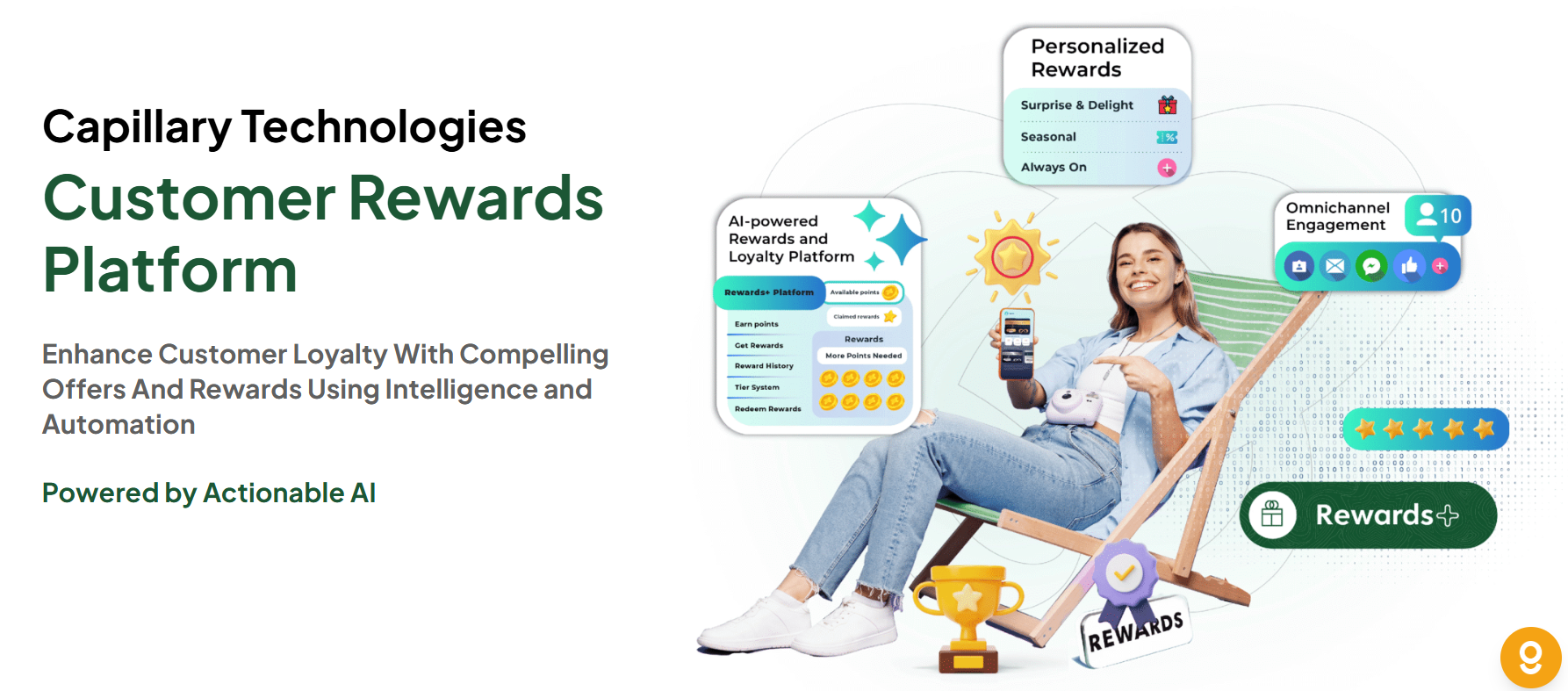
Capillary Technologies is a leading enterprise customer rewards platform serving over 400 million loyalty members globally.
Best for: Enterprise retailers and consumer brands seeking omnichannel behavioral loyalty with AI-powered personalization.
Standout Strengths:
- Recognized as a Leader in The Forrester Wave™: Loyalty Platforms, Q4 2025 report with the highest score out of 11 global loyalty vendors
- 390+ enterprise brands across 45+ countries
- Modular architecture allowing phased deployment of capabilities
- Proprietary aiRA AI engine delivers real-time behavioral personalization and next-best-reward decisioning
- Omnichannel orchestration across in-store (POS), online, mobile app, and social with unified customer profiles
- Named clients: Tata, Domino's, Dell, ASICS, IndiGo
- Strong in Asia-Pacific, US, and Middle Eastern regions with proven scale at leading retail and FMCG brands
Potential Limitations:
- Higher upfront implementation investment and longer time-to-value (3-6 months typically)
- Requires significant internal team involvement and data integration planning
Ideal Use Cases: Large retail networks, FMCG brands, restaurant chains, hospitality groups seeking behavioral loyalty tied to purchase patterns and engagement across channels.
Implementation Notes: Typically requires 3-6 month implementation, deep CRM/POS integration, and cross-functional team involvement. Strong for brands with mature data infrastructure.
2. Xoxoday Plum
Best for: Global enterprises needing the largest rewards catalog and fastest deployment in multiple geographies.
Standout Strengths:
- 10 million+ rewards options spanning 175+ countries with global fulfillment coverage
- Lowest cost of ownership among enterprise platforms (India-based pricing)
- White-label marketplace accelerates branded experience deployment
- API-first architecture enables rapid integration with existing martech stacks
Potential Limitations:
- Less specialized in behavioral personalization compared to pure omnichannel platforms
- Catalog breadth means less curation—requires strong internal category management
Ideal Use Cases: Multinational enterprises, global brands needing rapid multi-market deployment, organizations prioritizing reward variety and accessibility over deep personalization.
Implementation Notes: Faster deployment than full omnichannel platforms (4-8 weeks typical), strong API documentation, strong partner ecosystem in India and Asia-Pacific.
3. Kognitiv Marketplace
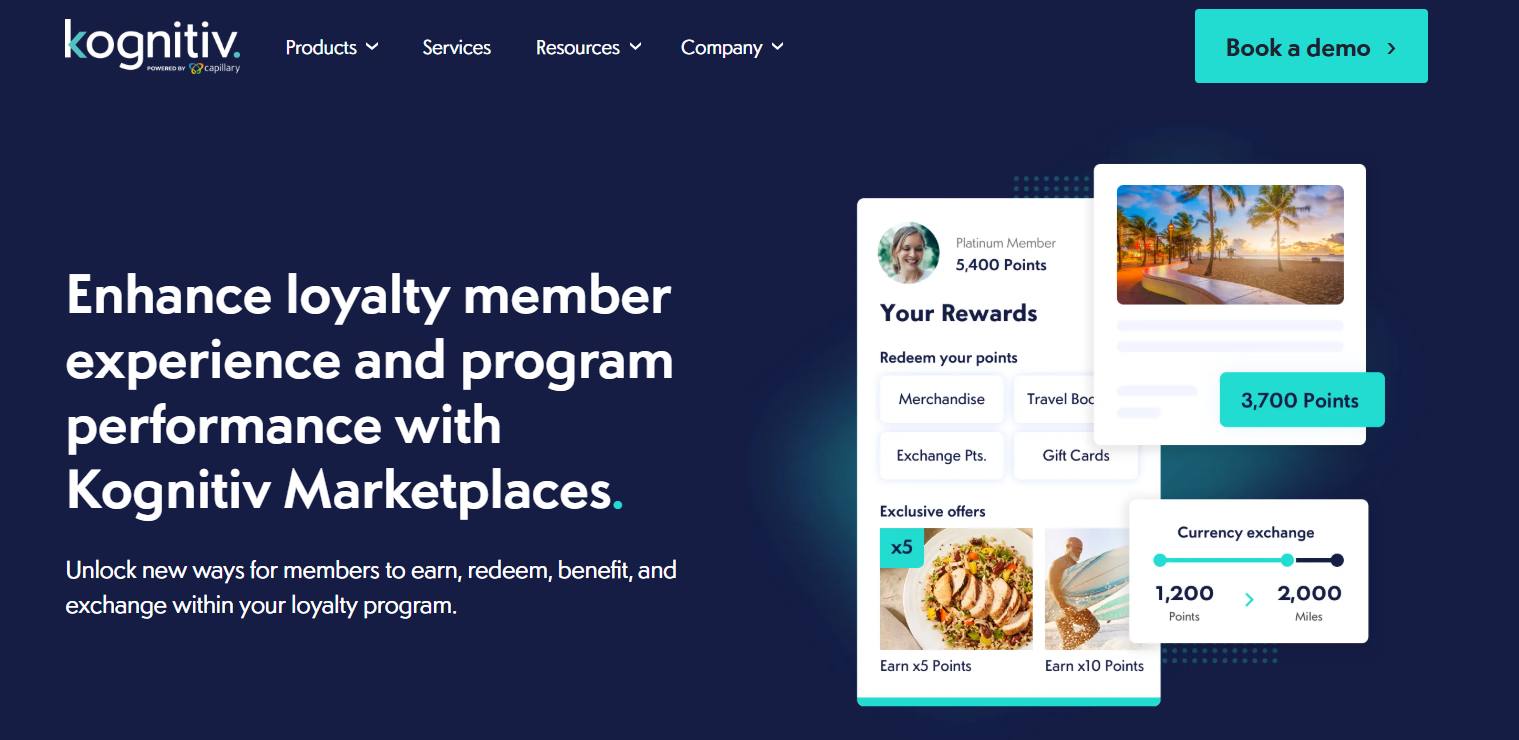
Best for: Travel, hospitality, and B2B2C partnerships focused on experiential and partner-based rewards.
Standout Strengths:
- Founded 2008, Toronto-based
- Specialized travel marketplace with 350K+ experiences globally
- Card-linked offers enable automatic earning without member action
- Currency exchange allows flexible redemption across partner brands
- 30+ enterprise brands including Petsmart, Hallmark, Yuu Rewards
Potential Limitations:
- Narrower focus on travel and partnerships (less suitable for transaction-based retail programs)
- Limited emphasis on points-based earning mechanics
Ideal Use Cases: Airlines, hotel chains, travel companies, partnerships seeking co-branded rewards, B2B2C models requiring partner benefit distribution.
Implementation Notes: 2-4 month typical implementation, strong for businesses expanding into travel and partnerships, API-first approach enables rapid partner onboarding.
4. Blackhawk Networks
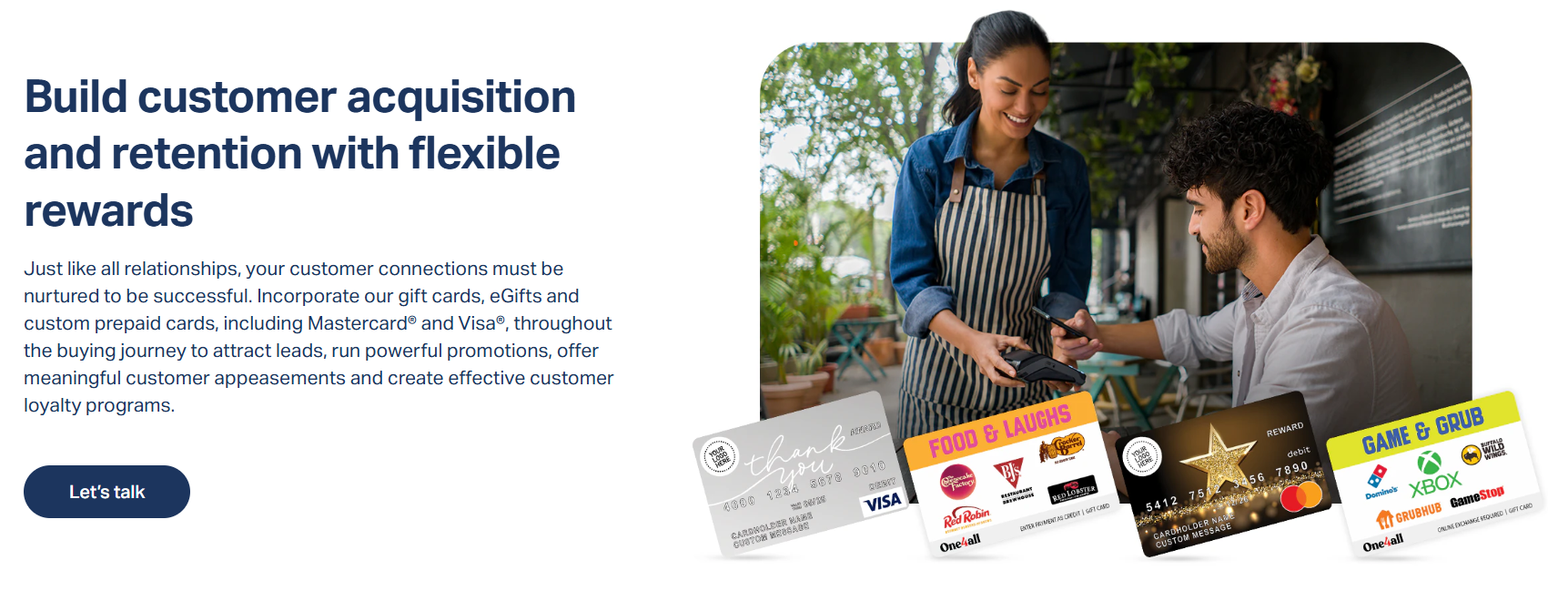
Best for: Large enterprises seeking consolidated rewards infrastructure, incentive management, and multi-program orchestration.
Standout Strengths:
- Consolidated player with portfolio including Tango Card, CashStar, Achievers (employee recognition
- Scales to massive transaction volumes with enterprise-grade infrastructure
- Breadth of reward types from gift cards to prepaid to incentive payouts
- Significant enterprise customer base with proven reliability
Potential Limitations:
- Transaction-focused rather than behavioral—stronger for payout than omnichannel personalization
- Higher cost structure typical for enterprise infrastructure providers
Ideal Use Cases: Large-scale B2B2C incentive programs, multi-brand enterprises, organizations with high redemption volumes, employee recognition + customer rewards combo.
Implementation Notes: Enterprise sales cycle typical, customizable integrations, strong for organizations with complex reward fulfillment requirements.
5. Kangaroo Rewards
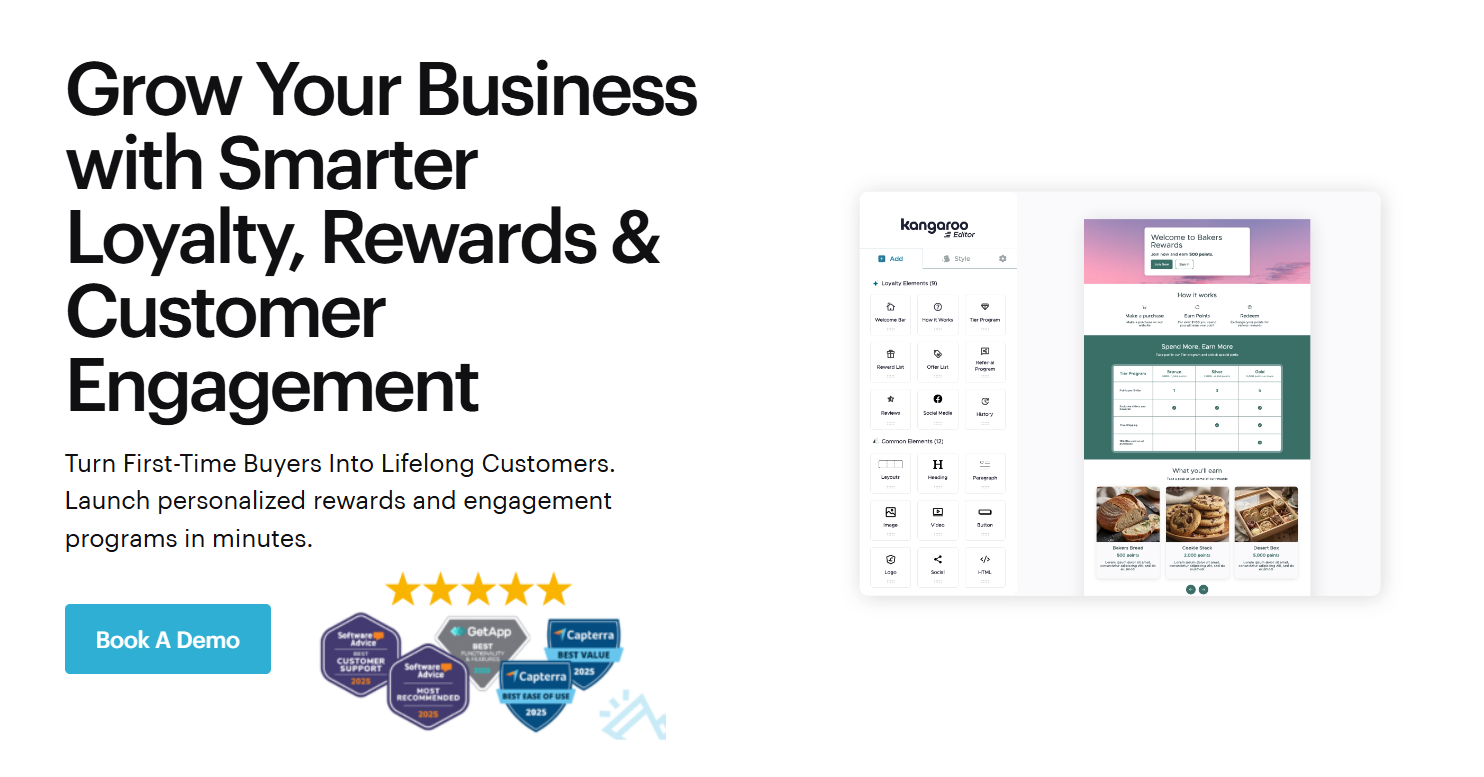
Best for: SMB and mid-market retailers and e-commerce brands seeking rapid, low-friction loyalty deployment.
Standout Strengths:
- Designed for fast deployment and ease of use without technical overhead
- Native Shopify and BigCommerce integration, plus POS support
- Proven 56% revenue lift for engaged SMB customers
- Mobile app with referral mechanics and gamification built-in
Potential Limitations:
- Limited advanced personalization and omnichannel orchestration
- Smaller reward catalog compared to enterprise platforms
Ideal Use Cases: Retail stores, e-commerce brands, SMB networks with limited internal resources, organizations prioritizing speed to market over feature depth.
Implementation Notes: 2-4 week deployment typical, minimal technical integration required, strong community support and case studies in Shopify ecosystem.
6. Tremendous
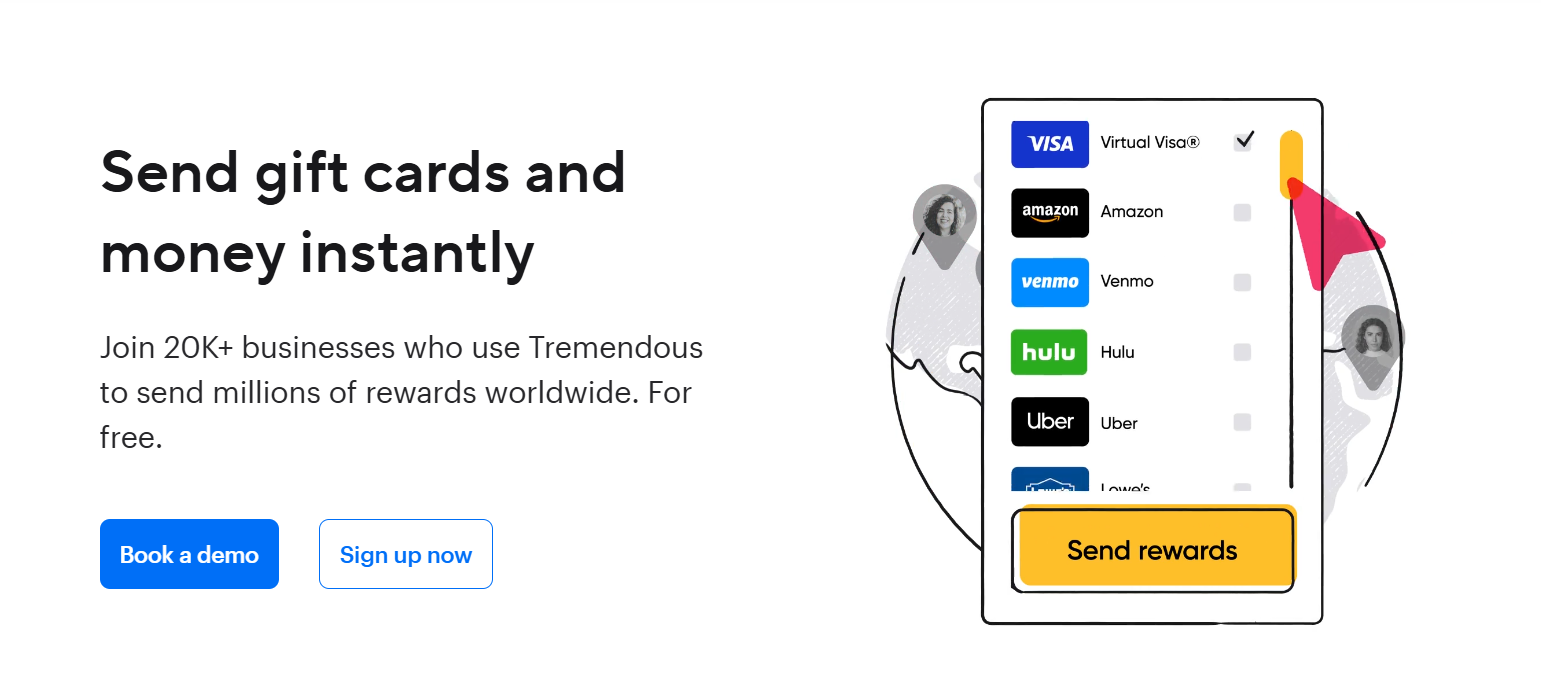
Best for: Organizations needing global payout simplicity and broad redemption options without complex program mechanics.
Standout Strengths:
- 2,500+ redemption options spanning 230+ countries with unmatched global reach
- API-first, developer-friendly architecture enabling rapid integration
- Handles gift cards, prepaid cards, cash payouts, and digital rewards seamlessly
- Ideal for research incentives, employee bonuses, referral rewards, and disbursements
Potential Limitations:
- Payout-focused rather than loyalty program design—lacks program builder and strategic personalization
- Not suitable for omnichannel or behavioral loyalty programs
Ideal Use Cases: Incentive programs, research participation rewards, employee bonuses, referral disbursements, B2B payout platforms.
Implementation Notes: Fast integration (1-2 weeks typical), minimal operational overhead, ideal as fulfillment layer for other systems.
7. Comarch Loyalty Management
Best for: Enterprise retailers operating multi-brand or coalition loyalty ecosystems requiring white-label flexibility.
Standout Strengths:
- Purpose-built for coalition loyalty models (multi-partner retail ecosystems)
- White-label portal enables brands to own customer experience
- Advanced analytics for multi-partner attribution and ROI measurement
- Strong in European market with Payback and Nectar model expertise
Potential Limitations:
- Coalition model limits applicability for single-brand direct programs
- Requires strong partner ecosystem management
Ideal Use Cases: Retail coalitions, multi-partner loyalty networks, European retailers, organizations seeking Payback/Nectar-style ecosystem models.
Implementation Notes: Complex deployment suited for enterprises with multi-partner governance, strong integration with partner POS and CRM systems required.
8. CustomerInspire Rewards Marketplace
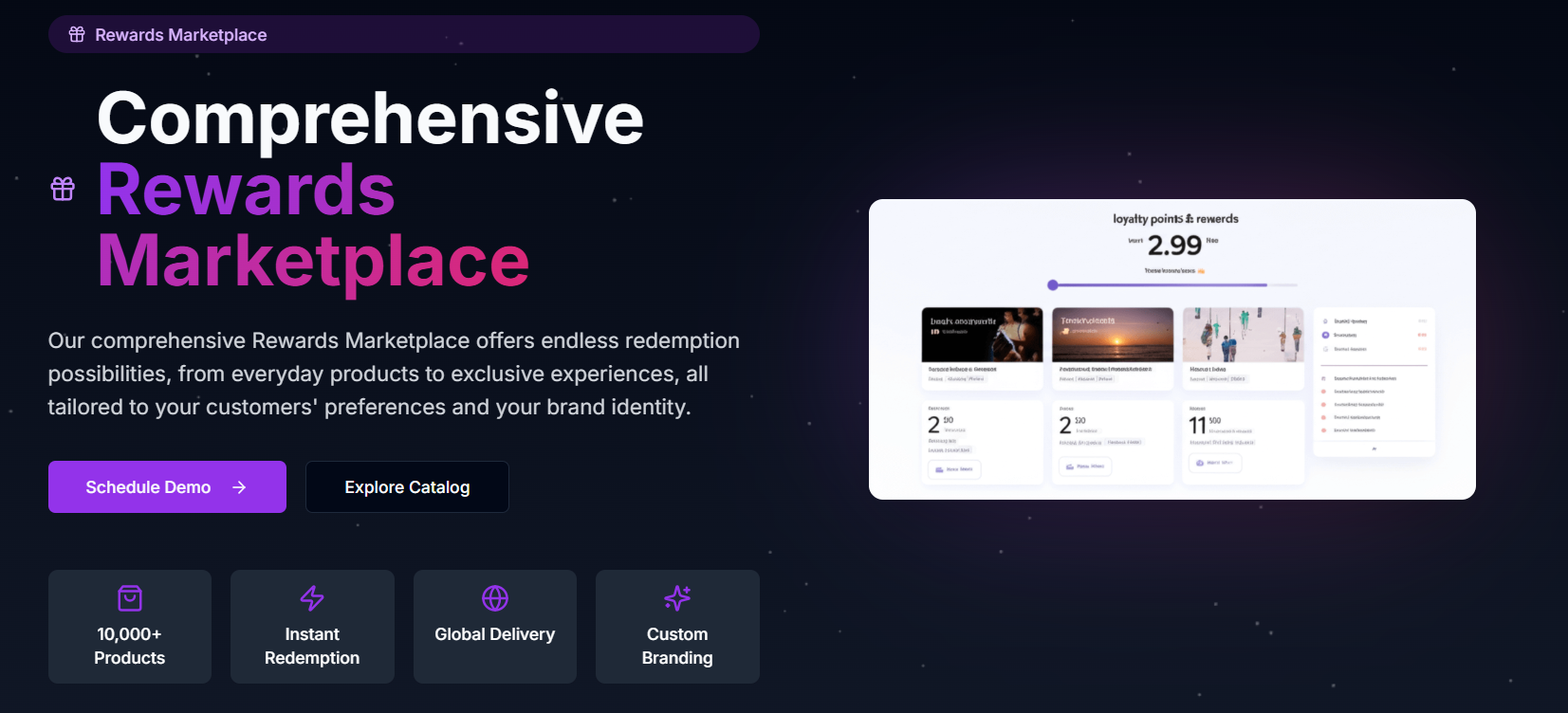
Best for: Airlines, telcos, and data-centric enterprises seeking AI-driven loyalty with vertical specialization.
Standout Strengths:
- Gen-AI powered loyalty with predictive analytics and behavioral insights
- Deep airline optimization (NetzSky booking integration, mileage mechanics)
- Merchant rewards integration for earning diversification
- Enterprise-grade compliance and data governance
Potential Limitations:
- Vertical specialization (airlines) may not translate to other industries
- Less emphasis on omnichannel retail orchestration
Ideal Use Cases: Airlines, telcos, financial services, enterprises with sophisticated analytics requirements, organizations seeking AI-driven member insights.
Implementation Notes: 4-6 month typical implementation for airlines, strong data analytics requirements, integrates with airline revenue systems.
Conclusion: Choosing Your Rewards Platform Based on Your Business
The right customer rewards platform depends entirely on your organization's maturity, business model, timeline, and strategic priorities. There is no universal winner—only the best fit for your specific context.
For retailers prioritizing behavioral loyalty and omnichannel experiences: Capillary Technologies delivers end-to-end orchestration with proven AI personalization. Plan for 3-6 months implementation and significant internal involvement, but expect measurable uplift in repeat purchase frequency and AOV.
For global enterprises needing rapid multi-market deployment: Xoxoday Plum's 10M+ catalog and 175+ country coverage enables fast launches with lower total cost of ownership. Expect deployment in 4-8 weeks with less internal resource intensity.
For SMBs seeking fast, low-friction loyalty: Kangaroo Rewards offers Shopify integration and 2-4 week deployment with minimal technical overhead. Ideal when speed and simplicity matter more than advanced personalization.
For enterprises managing complex fulfillment or coalition models: Kognitiv and Blackhawk Networks deliver infrastructure and white-label capabilities for scaled, multi-partner ecosystems.
For organizations needing global payout simplicity: Tremendous provides unmatched reach across 230+ countries with straightforward API integration—ideal for incentives, research rewards, and disbursements.
The consistent pattern across all successful programs: strong program design upfront, cross-functional ownership during implementation, disciplined measurement and governance throughout, and willingness to iterate based on member behavior and redemption data. Your platform choice matters, but execution discipline matters more. Select the platform that aligns with your timeline and team capabilities, invest in proper governance and measurement, and watch member engagement and business impact compound over time.
Frequently Asked Questions
What's the difference between a customer rewards platform and a loyalty app?
A loyalty app is the consumer-facing interface—the mobile experience where members check balances and redeem rewards. A customer rewards platform is the entire ecosystem: program design, data management, reward fulfillment, personalization engine, and the app itself. The platform is the system; the app is one delivery channel.
Can I migrate from one platform to another without losing member data?
Most reputable vendors support data migration and can export member profiles, points balances, and transaction history. However, migration is complex and requires careful planning. Ask vendors about data export capabilities, format standards, and migration timelines before signing. Plan 4-8 weeks for a clean migration on large customer bases.
How long does it take to see ROI from a customer rewards program?
Well-designed programs typically show positive ROI within 6-12 months as incremental revenue from higher-frequency members and repeat purchasers offsets program costs. However, the timeline varies by industry, program complexity, and member base size. Quick-wins (30-60 days) are possible with simple point-based programs; complex behavioral programs may take 12-18 months to optimize.
What's the typical cost of a customer rewards platform?
Pricing models vary widely. Enterprise platforms range from $50K-$500K+ annually depending on member base and features. SMB platforms often charge per-member ($0.50-$2.00/member/month) or flat SaaS fees ($5K-$20K/month). Implementation costs typically range from $50K-$500K depending on complexity and integrations. Request detailed RFPs to compare total cost of ownership across options.
Do I need a dedicated team to manage a rewards platform?
Yes, the platform is just the tool. You'll need cross-functional ownership: a program manager (strategy and operations), a marketing lead (member engagement), a financial controller (budget management), and technical resources (integrations and data). Most organizations allocate 2-4 full-time equivalent staff initially; smaller teams can manage with outsourced consulting.
How do I measure the true incremental impact of my loyalty program?
Design proper measurement from inception: establish a control group of non-loyalty members, track purchase behavior over time, calculate CLV (customer lifetime value) for loyalty members vs. controls, and isolate program impact from other marketing activities. Use attribution modeling to understand which program mechanics drive which outcomes. This requires clean data, statistical rigor, and analytical capability—not all platforms provide built-in incrementality measurement.
Can a customer rewards platform integrate with my existing CRM and POS systems?
Most modern platforms support integrations via APIs or pre-built connectors. However, integration quality varies significantly. Ask vendors specifically about your CRM, POS, and CDP systems. Request technical architecture documentation. Budget 8-12 weeks for integrations and plan for potential custom development. Integration depth often determines your platform's success—don't underestimate this work.
What reward types should I offer?
Start with what resonates with your members. Conduct preference research or analyze competitor programs in your category. Most successful programs layer multiple reward types: points for long-term engagement, cashback for price-sensitive segments, gift cards for accessibility, experiences for emotional connection, and partner offers for value extension. Test different mixes with member cohorts and iterate based on redemption data.